Small Steps VIII — Build with Several Files
Give Each File a Job
Pass values to a function and receive its result.
Separate the score calculation
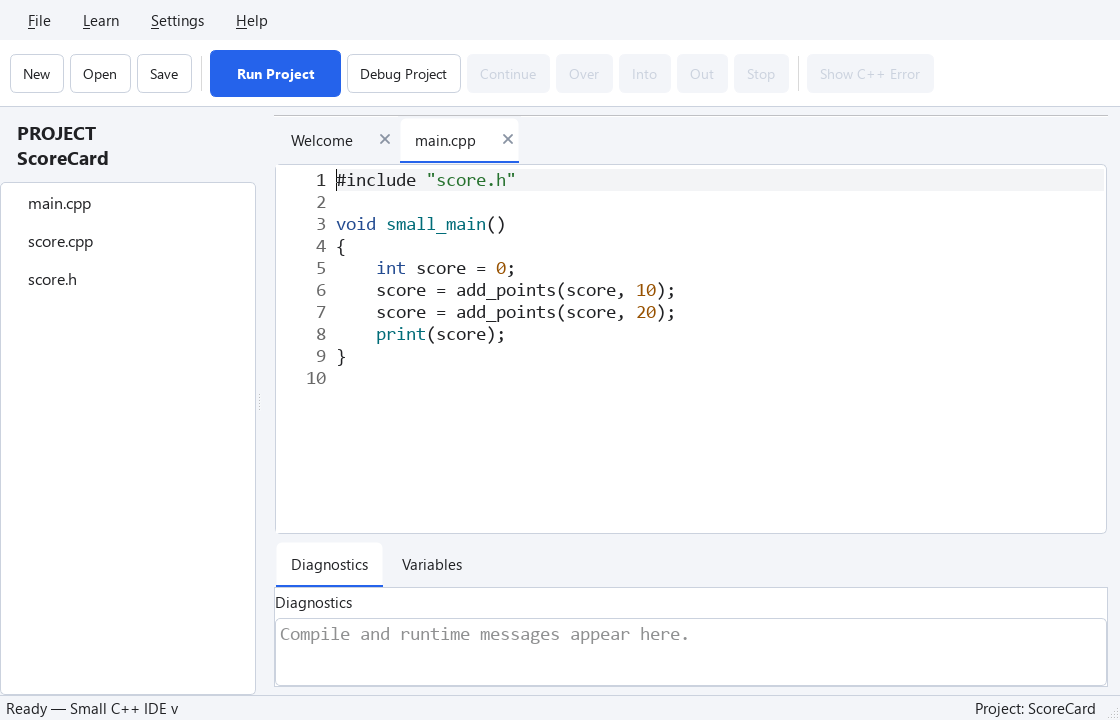
Name files after their jobs. Create a new ScoreCard project. Keep main.cpp, score.h, and score.cpp in the same folder and replace their contents as follows.
score.h
#pragma once

int add_points(int score, int points);
score.cpp
#include "score.h"

int add_points(int score, int points)
{
    return score + points;
}
main.cpp
#include "score.h"

void small_main()
{
    int score = 0;
    score = add_points(score, 10);
    score = add_points(score, 20);
    print(score);
}
Run Project prints 30. main.cpp controls the program's flow; score.cpp handles the calculation. The score is a local variable in main. Passing values in and returning a new value avoids a shared global variable.
Start with a header named after its source file. Put function declarations in the header and definitions in the source. You do not need a separate file for every small function.
Check the behavior in one file
int add_points(int score, int points)
{
    return score + points;
}

void small_main()
{
    int score = 0;
    score = add_points(score, 10);
    score = add_points(score, 20);
    print(score);
}
Exercise — Check it yourself
Add another call worth 5 points to print 35 in the one-file practice. Then add the same call to main.cpp in your project. Do score.h and score.cpp need to change?
int add_points(int score, int points)
{
    return score + points;
}

void small_main()
{
    int score = 0;
    score = add_points(score, 10);
    score = add_points(score, 20);
    print(score);
}
Hint
Use the menus described above. The solution below is for the one-file practice. Apply the same change to the file with that job in your project.
show solution
int add_points(int score, int points)
{
    return score + points;
}

void small_main()
{
    int score = 0;
    score = add_points(score, 10);
    score = add_points(score, 20);
    score = add_points(score, 5);
    print(score);
}